
Ective | September 25, 2026
An invoice arrives as a scanned PDF, an insurance form includes handwriting, and a supplier statement uses a layout your team has never seen. Someone still has to find the right values, check them, and enter them into SAP, Salesforce, or another business system. The ability to convert PDFs into database records changes that operating model from manual interpretation to a controlled, auditable data flow.
The objective is not simply to pull text from a file. A usable database record needs the correct fields, the correct formats, the right match to existing master data, and a reliable path into the system where work happens. That distinction is where many PDF extraction projects either deliver measurable results or create a new queue of exceptions.
A PDF is a visual container, not a database table. Even PDFs that look consistent to a person can vary in text position, page order, language, scan quality, and field labels. A vendor may place an invoice number in the header on one document and beside a barcode on the next. Totals may use different decimal and date formats. A purchase order may contain line items spread across several pages.
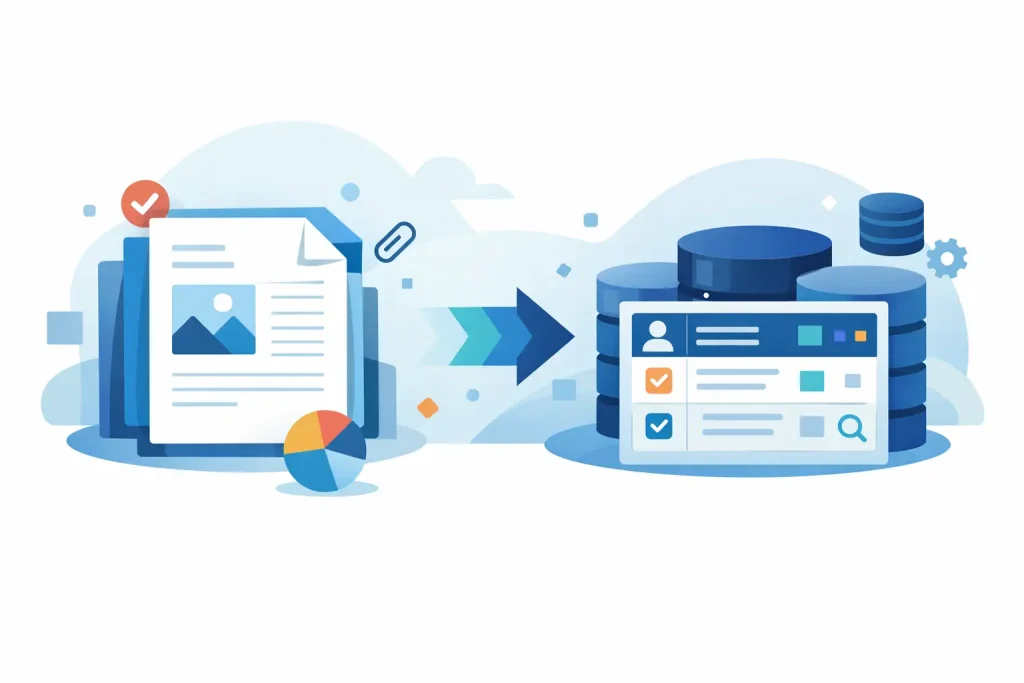
Converting these documents into database records requires four connected stages: capture, understand, validate, and deliver. OCR captures text from scans and image-based PDFs. AI document understanding identifies what that text means in context. Validation tests whether the extracted values are credible and usable. Integration sends approved records to the target application, workflow, or database.
Leaving out any stage introduces risk. OCR alone can read a character string but cannot reliably determine whether it is an invoice number, a tax ID, or a shipment reference. AI extraction without validation can return plausible-looking values that do not belong in production systems. And a correct extraction that remains in an isolated portal has not removed the operational bottleneck.
The strongest implementations begin with the data model, not the document. Define the record that the receiving system requires: supplier name, invoice number, invoice date, currency, net amount, tax amount, total amount, purchase order number, cost center, and line-item fields where applicable.
For each field, establish what counts as valid. An invoice date should be a valid date in the required format. A supplier should match an approved supplier record. Currency should come from an accepted set of values. Totals should reconcile with the net amount and tax. These rules turn extraction from a best-effort reading exercise into a business process.
It also helps to decide what should happen when a field is missing or uncertain. Low-confidence records can be routed to a review queue, while records that pass confidence thresholds and business rules can proceed automatically. The right threshold depends on the process. A marketing contact import may tolerate more variation than an accounts-payable posting or a claims decision.
Modern AI document processing should not require a long model-training project before a team can test a workflow. Business users need to describe the document type and the fields they need, then refine the process based on actual exceptions.
A practical workflow typically defines the document classification, requested fields, extraction instructions, validation rules, approval path, and system handoff. Natural-language prompts can specify what to extract and how to interpret a field. For example, an instruction can distinguish the invoice total from a subtotal, identify the remit-to address separately from the supplier address, or request line items with quantity, unit price, and amount.
This approach is especially useful when layouts vary across suppliers, regions, or business units. Instead of creating and maintaining a template for every format, the workflow focuses on the business meaning of the required information. That does not eliminate the need for governance. It makes governance more accessible because operations teams can participate directly in configuration rather than waiting for a specialist development cycle.
Validation is the control layer that protects downstream systems. It should combine document-level logic with company data and process-specific rules.
A supplier name extracted from a PDF may be correct as text but still need matching against vendor master data. A purchase order number may need confirmation against an open-order list. A total may need to equal the sum of line items, subject to rounding rules. Duplicate invoice detection may compare supplier, invoice number, date, and amount before a record is created.
These checks reduce the number of records that require human attention while making the review queue more useful. Reviewers should see the document, extracted values, confidence signals, and the precise reason the record failed validation. “Needs review” is not actionable. “Supplier does not match vendor master” or “Invoice total differs from calculated line-item total by $125.00” is actionable.
This is also where exception handling becomes a design decision rather than an afterthought. If a new supplier appears, the workflow may route the record to vendor onboarding. If a currency is unsupported, it may go to a regional finance team. If the document is unreadable, the system can request a clearer source or flag it for manual processing.
The final step is to create or update the database record without adding manual handoffs. The best integration pattern depends on the systems involved, transaction volume, and governance requirements.
For high-volume operational processes, direct API integration can send validated records into an ERP, CRM, case-management platform, or purpose-built database. This is useful when the target system supports real-time or near-real-time record creation and when immediate visibility matters.
For broader automation programs, an extraction platform can hand structured data to Microsoft Power Platform, UiPath, Blue Prism, ServiceNow, or another orchestration layer. That pattern works well when the record must trigger approvals, notifications, reconciliations, or follow-on tasks across several applications.
Batch delivery may be appropriate for legacy systems or controlled finance processes. In those cases, validated data can be delivered in a governed format at scheduled intervals. It is not inherently inferior to real-time integration. It simply needs clear ownership, error reporting, and reconciliation controls.
Regardless of the pattern, preserve the connection between the database record and its source PDF. A document reference, storage ID, or audit trail allows teams to trace a field back to the original page. This matters during audits, disputes, payment investigations, and process improvement reviews.
Extraction accuracy is important, but it is not the only metric that matters. A system can achieve strong text recognition and still create operational friction if too many documents fail master-data matching or require manual correction.
Track field-level accuracy for critical values, straight-through processing rate, exception rate, average review time, and time from document arrival to record availability. Also monitor why exceptions occur. If most exceptions result from an outdated vendor master, the solution is not another extraction tweak. If a single document source causes repeated failures, the team may need a source-specific rule or a discussion with that supplier.
Speed to production should be measured as well. Long implementation timelines delay savings and often signal excessive dependence on custom templates, model training, or code. EctiveXtract is designed to let teams configure extraction workflows through prompts and rules, target 90%+ day-one accuracy, and deploy production workflows in under five hours when the process and data access are ready.
PDFs often contain financial, customer, employee, or regulated information. The extraction workflow should therefore follow the same security expectations as the systems receiving the records. Define access rights for document viewing, workflow configuration, review queues, and exports. Retain documents and extracted data according to company policy, and maintain logs for user actions and record changes.
Deployment architecture also matters. Managed Azure hosting may fit organizations that want fast adoption within an established cloud environment. Hybrid deployment can support organizations that need closer control of document movement. Customer-controlled on-premise storage may be necessary when document residency or internal policies limit where source files can live.
The requirement is not one architecture for every organization. The requirement is that security, storage, and integration decisions are explicit before documents enter production.
The first workflow does not need to solve every document variation on day one. Start with a high-volume process, define the required record and validation controls, and examine the exceptions that remain. Each exception category reveals something useful: a missing rule, a data-quality issue, an unfamiliar layout, or a process decision that was never formalized.
When PDFs become validated records rather than emails waiting in a queue, teams gain faster processing without giving up control. Begin with the records your operation needs most, make the validation logic visible, and let exceptions show you where the next improvement will pay off.